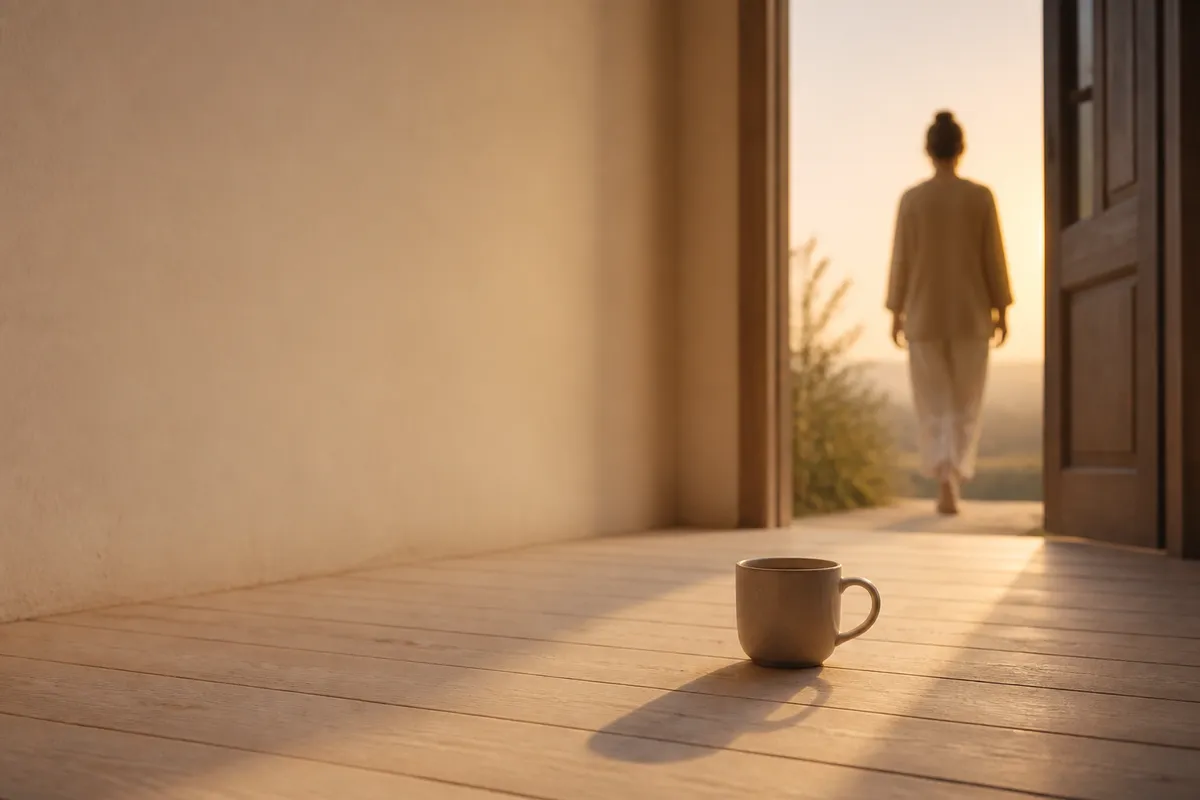
If you only build one health habit this year, make it this one: get outside into daylight within an hour of waking. It’s the best-evidenced, lowest-effort thing you can do for your sleep, your energy and your mood — and it costs nothing.
Light is the master switch
Your body runs on a roughly 24-hour clock, and light is what sets it. Morning light through your eyes anchors your circadian phase and starts a timer: melatonin, the hormone that makes you sleepy, rises about 14–16 hours later. In other words, a bright morning quietly earns you an easy bedtime that night. Skip it, and the whole day drifts.
Two details that surprise people:
- It’s your eyes, not your skin. This is a light signal, not a UV or vitamin-D thing. You don’t need to tan, and it works with a UV index of zero.
- Cloudy still counts. An overcast sky outdoors delivers far more circadian light than even a bright room indoors — on the order of ten to one. So “it’s grey out” is not an excuse; stepping outside still works.
Five to thirty minutes is plenty. Pair it with something you already do — coffee on the step, the first dog walk, a short walk to nowhere.
The evening is the other half
If morning light turns the clock on, bright evening light muddies it. Expert consensus recommends plenty of light during the day and dim, low light in the hours before bed. You don’t need blue-light glasses so much as less light, later — dim the lamps, park the screens, let your body get the signal that night has arrived.
The habit that beats all the others: regularity
Here’s the finding that reframes everything. In a study of nearly 61,000 people wearing motion trackers, how regular their sleep was predicted mortality better than how much they slept. Same bedtime, same wake time — even on weekends — turns out to be the single highest-leverage sleep habit known. Morning light is what makes that regularity easy, because it stabilises the clock that sets your bedtime.
How Biokei helps: it nudges you into your morning-light window, tracks your daily daylight automatically, and shows it on one timeline next to your sleep — so you can see the mornings that earned your best nights.
Medical disclaimer: Biokei shows estimates to guide healthy habits, not medical advice.
- Brown TM, et al. Recommendations for daytime, evening and nighttime indoor light exposure. PLoS Biol. 2022. ncbi.nlm.nih.gov/pmc/articles/PMC8929548
- Windred DP, et al. Sleep regularity is a stronger predictor of mortality risk than sleep duration. SLEEP. 2024. academic.oup.com/sleep
- Lambert GW, et al. Effect of sunlight and season on serotonin turnover in the brain. Lancet. 2002.